
Beyond Rockets. SpaceX
Elon Musk’s Ultimate Moat

Elon Musk
Btw, Elon, if you are reading this, hey there!
Despite the constant controversies and his political involvement, I really admire Elon Musk. Why? Because he refuses to just accept traditions or the way things have always been done.
Instead of following the crowd, he questions everything and challenges the status quo. That kind of thinking is what actually drives human progress forward, do you agree?
I won’t bother listing his whole life story here. Elon is still relatively young, though you could already fill libraries with books about him. But his mindset of questioning how things work is what makes him stand out. Here in short:
Elon Musk is a South African-born American entrepreneur, engineer, and billionaire businessman known for his work across the automotive, aerospace, artificial intelligence, and infrastructure industries.
He started his first company, Zip2 (1995), an online business directory and web software provider for newspapers, alongside his brother Kimbal. Elon was not that young, he was 24! At the age of 27 he was already a millionaire. Zip2 was sold to Compaq in 1999 for over $300 million.

Young Elon and Kimbal Musk
While he is heavily associated with Tesla (which he joined early as an investor and chairman in 2004, though it was originally founded by others), Musk has founded or co-founded several major companies throughout his career:
X.com (1999): An online financial services and email payments company that later merged to become PayPal.
SpaceX (2002): Space Exploration Technologies Corp., focused on reducing space transportation costs and enabling the colonization of Mars (including the Starlink satellite internet network).
OpenAI (2015): Co-founded as a non-profit artificial intelligence research lab.
Neuralink (2016): A neurotechnology company developing implantable brain-machine interfaces.
The Boring Company (2016): An infrastructure and tunnel construction company designed to ease urban traffic.
xAI (2023): An artificial intelligence company focused on understanding the true nature of the universe, creator of the Grok chatbot.
He also acquired Twitter in 2022, subsequently rebranding and restructuring it as X Corp.
Have you noticed Elon’s obsession with the letter “X”? There’s x.com, SpaceX, xAI, and X Corp!
However, this article is dedicated entirely to his venture SpaceX.
SpaceX. A Rocket Company? Not Only.
Elon Musk founded SpaceX in 2002 with the explicit long-term goal of making humanity multi-planetary and dramatically cutting the cost of space travel. The idea is simple: you don't throw away the car after a single ride. That's exactly how Musk believed rockets should work.
In the beginning, SpaceX faced a brutal battle. The aerospace establishment and government regulators weren’t welcoming, they viewed space exploration as exclusive government territory and put up massive roadblocks for a private startup.
The early days were a survival test. The first three rocket launches all failed, pushing the company to the brink of bankruptcy. With money running completely out, the fourth launch was a moment. Had it failed, SpaceX likely would not exist today.
For over two decades it stayed private, funded through 32+! rounds totaling roughly $12 billion from investors like Andreessen Horowitz, Founders Fund, Sequoia, Fidelity, and Google Ventures. Its private valuation climbed steadily, $137B in early 2023, $350B in late 2024, $400B by mid-2025, and around $800B by December 2025 via an insider share sale.
Where SpaceX stands now?
At its core, the company is built on three pillars: Space, Connectivity, and Artificial Intelligence.
Space (Falcon, Dragon, Starship): Dominates the global stage, executing more orbital launches each year than any other competitor, beating out even major national space programs.
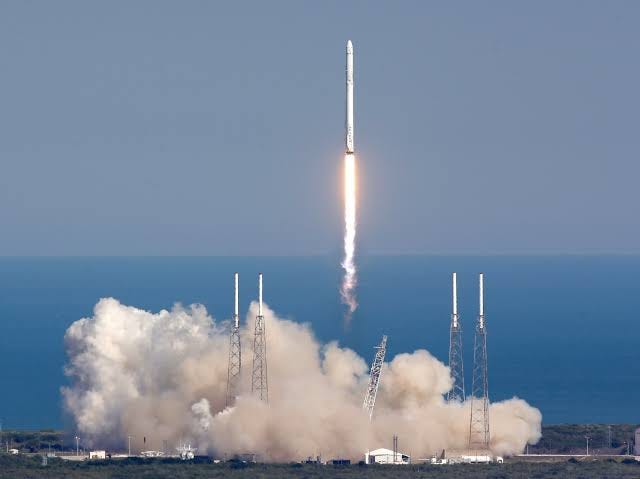
SpaceX rocket
Connectivity: Powers Starlink, a massive global satellite internet network.
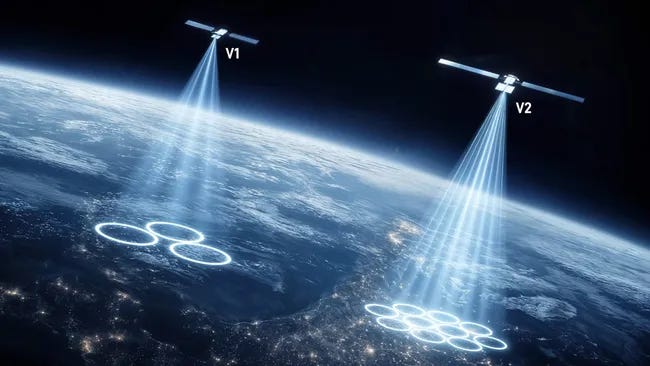
Starlink sattelites
Artificial Intelligence: Manages data centers, X, and the Grok AI model. These assets were originally part of xAI before being acquired by SpaceX in early 2026, ahead of its IPO. Important to notice: X (formerly Twitter) ended up under xAI, not that xAI was under X.
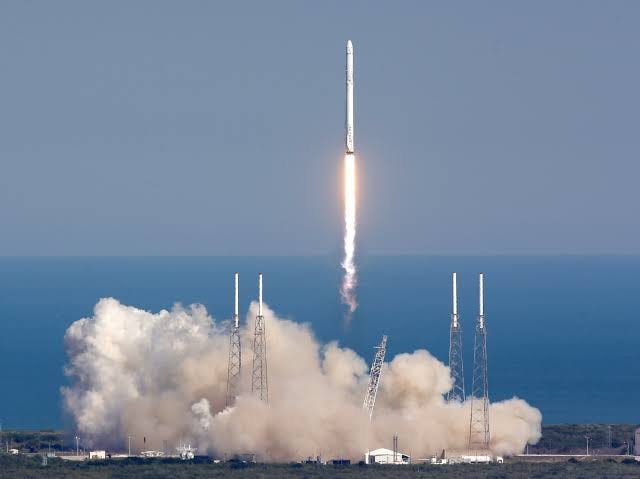
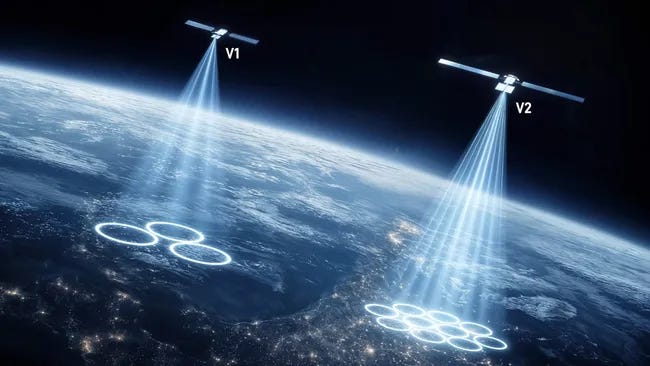
SpaceX has about 22,000 employees and recently completed a 13th Starship flight test, described as largely successful.
Despite the heavy-hitting presence of the space and AI divisions, Starlink is the undisputed financial engine of the entire enterprise. While the AI venture is currently burning through cash at a rapid pace, Starlink remains the sole profitable division.
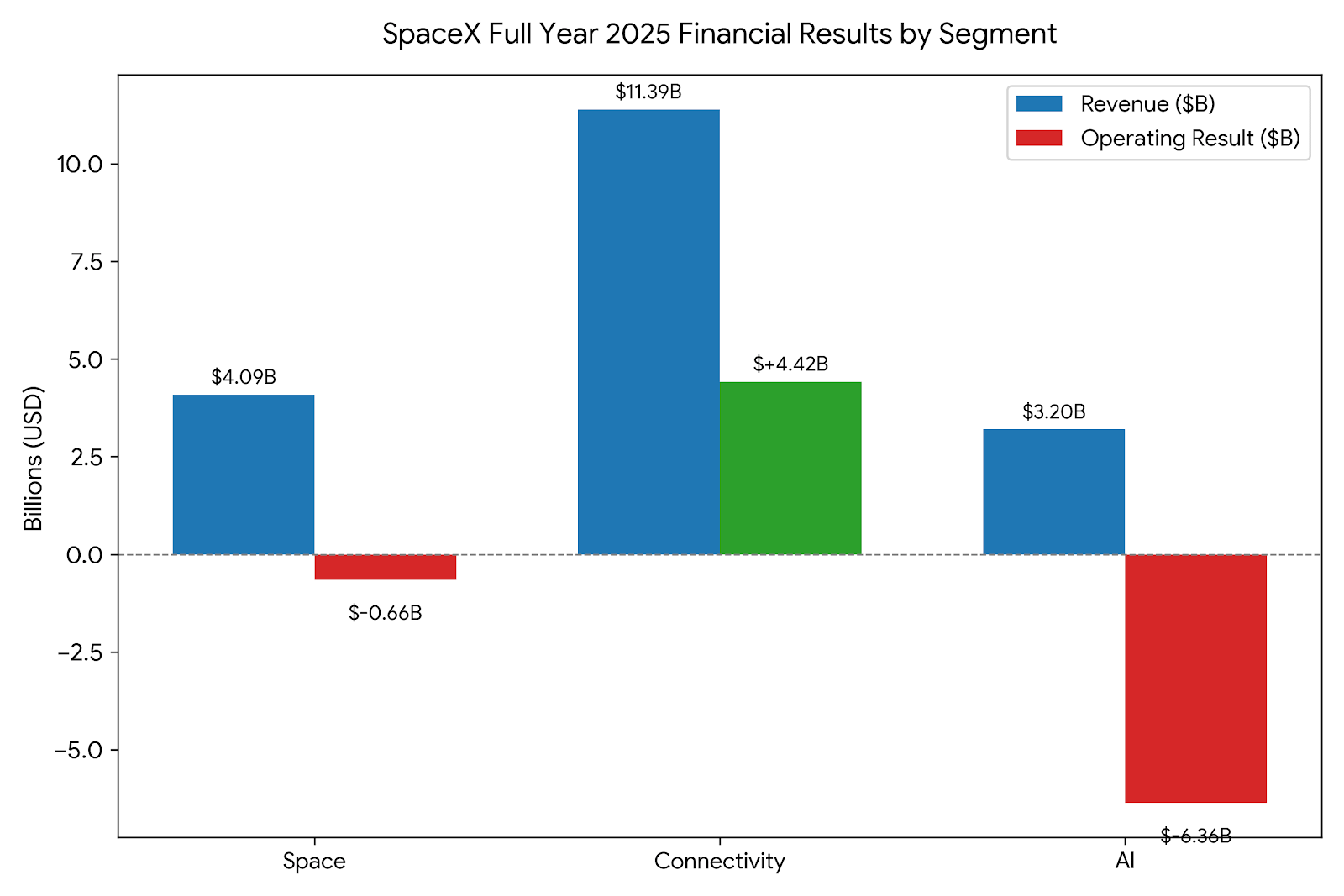
SpaceX made 18.7 billion in revenue for 2025 but lost 4.9 overall, and that loss actually widened further into Q1 2026, losing 4.1 billion in just 3 months. Despite strong top-line growth, the company was solidly in the red for the year, primarily driven by the AI segment's losses.
Are There Any Moats? Clearly!
The Space Division
The Ultimate Price Cut: By figuring out how to land and reuse rockets instead of throwing them away after a single flight, this division slashed the cost of getting into orbit. Competitors and traditional government space agencies simply cannot compete on price.
The Go-To Transport: Because they fly more often than anyone else on Earth, they get safer, faster, and cheaper with every single launch. It has essentially become the global highway to space, trusted by both commercial giants and the military for critical missions.
The Connectivity Division (Starlink)
Beating Everyone to the Sky: Starlink put thousands of internet satellites into low-Earth orbit before anyone else could even get their plans off the ground. That massive head start is nearly impossible for a newcomer to match.
The In-House Advantage: Unlike traditional telecom companies that have to buy expensive third-party gear, Starlink gets its rides to space built and flown by its own sister division at cost. That keeps expenses remarkably low while building a massive, global base of paying subscribers.
The Artificial Intelligence Division
Some analysts may disagree with me and argue that xAI has no moat at all. That’s a fair point. Grok is still not particularly popular, accounting for only about 3% of AI chatbot web traffic, and its share has remained largely flat over the past year. Meanwhile, ChatGPT, Google’s Gemini, and Anthropic’s Claude have all expanded their user bases.
Even so, I believe there is meaningful long term potential. And I’m not referring only to the chatbot itself. The real opportunity may lie in the broader ecosystem, particularly xAI’s AI infrastructure and data centers, which could become a significant competitive advantage as demand for AI computing continues to grow.
Brute-Force Compute: Backed by enormous data centers, they possess the raw processing muscle needed to go with the biggest names in tech. Down the road, they even have the unique potential to move data centers right into space, tapping into endless solar power and natural cooling to bypass Earth’s crowded energy grids.
A Firehose of Real-Time Data: While other AI labs struggle to find fresh, high-quality data to train their models, this division has direct, exclusive access to a massive global stream of live human conversation and news.
Going Public (IPO)
A private company sells shares to the public for the first time. In exchange for cash, investors get ownership stakes (shares). The company gets listed on an exchange like the NYSE or Nasdaq, and after that, anyone can buy or sell those shares.
Share types
Most public companies keep it simple with one class of “common stock” , one share, one vote. But some companies (especially tech, like Google or Meta) use multiple classes:
Class A sold to the public, usually 1 vote per share
Class B held by founders/insiders, often 10 votes per share
Preferred stock sometimes exists too, usually held by early investors,gives priority on dividends or payout if the company is sold, but often little or no voting power
This lets founders raise public money while keeping control.
Governance structure
Shareholders: own the company, vote on big things (electing the board, mergers, major changes). Voting power depends on shares held.
Board of Directors: elected by shareholders. Sets overall strategy, hires/fires the CEO, oversees major decisions. Usually includes independent (outside) members plus a few insiders.
Board committees: smaller groups handling specific jobs, like the Audit Committee (checks the finances), Compensation Committee (sets executive pay), Nominating/Governance Committee (picks future board members).
Executives (CEO, CFO, etc.): run day-to-day operations, report to the board.
Chain of accountability
Shareholders → elect → Board → hires/oversees → CEO and management → runs the company
So the short version: shareholders own it, the board oversees it, executives run it and share classes decide how much say each owner actually gets.
SpaceX Remains Fully Controlled by Musk
SpaceX went public on June 12, 2026, on the Nasdaq under the ticker SPCX, in what became the largest IPO in history, priced at $135 a share and raising roughly $75 billion.
Here’s the model they picked:
Dual-class structure, tilted hard toward Musk. SpaceX used the same trick as Google, Meta, and Ford before it: public investors get one class of shares, insiders get another with outsized voting power. But SpaceX pushed it further than almost anyone: Musk controls about 85% of SpaceX’s shareholder voting power, even though he doesn’t own anywhere near 85% of the economic value. Pretty unfair to regular shareholders, don’t you agree?
Unusually generous retail allocation. Most IPOs hand only a sliver of shares to ordinary individual investors and save the rest for big institutions. SpaceX flipped that: roughly 30% of the offering was set aside for retail investors, distributed through everyday brokerages like Schwab, Fidelity, Robinhood, and SoFi. Basically anyone could buy it at the IPO.
So! One class for the public, one super-voting class for Musk, a big slice deliberately handed to retail buyers, and a valuation that made it the biggest debut on Wall Street.
Let me explain ownership vs. control: It’s genuinely one of the most concentrated ownership setups of any major public company I’ve ever seen! Musk owns roughly 42% of SpaceX’s equity, but that’s not the number that matters. Through SpaceX’s final S-1/A filing, Class B shares carry 10 votes per share versus 1 vote for Class A, giving Musk approximately 85.1% of the voting power despite owning less than half the company. He holds this by owning 12.3% of Class A shares and 93.6% of Class B shares. Elon is CEO, CTO, and Chairman of the Board. Per the prospectus, Musk controls the election of a majority of the board directly through his Class B shares.
Who can fire Musk?
Musk can only be removed from his roles as Chairman, CEO, and CTO by a vote of Class B shareholders. Since he personally controls the vast majority of Class B votes, this provision essentially lets him veto his own removal. In practice, no one can fire him against his will under this structure. Pretty smart, huh?
Bottom line: public shareholders own a large slice of the economics but essentially none of the control. It’s a governance model, not an accident.
Because Musk controls the majority vote, SpaceX qualifies as a “controlled company” under Nasdaq rules, which exempts it from several standard governance requirements, like needing a majority-independent board.
My Take
Shares priced at $135, opened around $150 and the company debuted at a valuation near $1.8–2.3 trillion depending on the source. Musk reportedly made a deliberate push to give retail investors meaningful access to shares rather than the usual Wall Street-heavy allocation.
The stock has been volatile. It peaked intraday around $225.64 on June 16, then fell hard. As of late July 2026 it’s trading around $113–115, roughly 15–22% below the IPO price and about 49-51% off its post-IPO high, putting the market cap near $1.49 trillion.
Reaction is split. Analysts remain broadly bullish on paper: around 27 “buy” ratings vs. 1 “sell”. Firms like Raymond James have reiterated strong buy ratings. But there’s real skepticism too: Morningstar (my former employer! Love you, guys) called it “significantly overvalued” before the IPO, valuing it closer to $780B versus the $1.5-2T+ private/IPO targets. Morgan Stanley has flagged a valuation gap.
SpaceX has genuine, durable competitive advantages, it dominates commercial launch. Starlink is a real and growing revenue engine, and it has a long head start on reusable rocket technology. That’s different from, say, a hype-only IPO. But the stock’s volatility since debut suggests the market is still trying to figure out how to value a company that’s part rocket company, part satellite internet provider, and now part AI company (via the xAI merger), three very different businesses bundled together, each with its own risk profile.
Disclaimer: I hold only a tiny amount of SpaceX shares. Just for fun!
If you enjoyed this article, please like, leave a comment, and subscribe for more insights on startups, technology, and the companies shaping the future. I love your support!