
Choosing a Cofounder or Why Mediocrity Is the Silent Startup Killer

Most founders obsess over market size, product strategy, or fundraising. The truth is that teams collapse far more often than ideas. As I wrote in my post before, roughly 65% of high-potential startups fail because of conflicts between cofounders. Many people rush into partnerships with individuals they barely know. This often leads to early fractures, slow decision making, and in painful cases, companies that fall apart just when they start gaining traction. Strong cofounders should be steady under pressure. They should be decisive, resilient, and ideally known or tested over time. Domain expertise matters. Character and compatibility matter more.
Do You Even Need a Cofounder?
Before you start drafting job posts as “Cofounder Wanted” ads, ask yourself an honest question:
Do I actually need someone right now?
The most successful founders hire only when a role becomes absolutely unavoidable. If you can survive without that person, you probably should. Early hiring must be brutally selective. Every cofounder becomes part of the company’s DNA. Every personality adds or subtracts momentum. Every wrong hire multiplies complexity.
When you do hire, hire for mission, dedication, and cultural fit. Skills can be taught. Methods can be learned.
The Cofounder Rule #1: The Right One Is Usually Someone You Already Know
The person you choose as a cofounder will influence every part of your journey. The longer you have known them, the better. There is a romantic idea that two strangers meet at a hackathon and build the next unicorn. It looks perfect in a documentary. It makes for high-energy headlines. It almost never survives real life. Startups demand trust at a level that is difficult to manufacture on short notice.

Real success usually grows out of relationships that have already been pressure tested. Think about the origins of Robinhood. Baiju Bhatt and Vlad Tenev were not random acquaintances. They had worked together, studied together, and built side projects. Their collaboration had already endured late nights, technical disagreements, and the small frictions that reveal who stays calm and who cracks. When they decided to start a company, they were not just betting on an idea. They were betting on a relationship they already knew they could depend on.
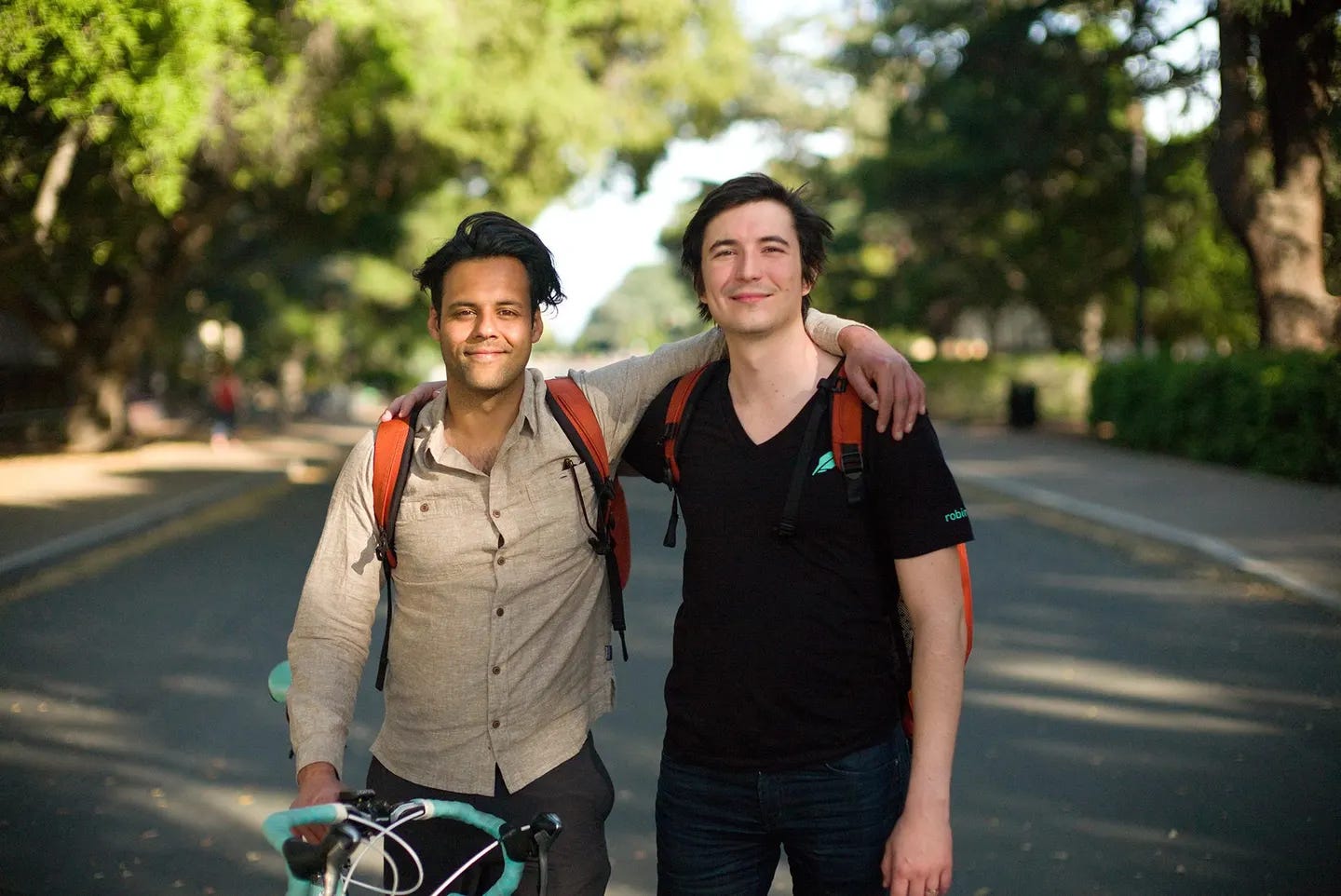
Baiju Bhatt and Vlad Tenev co-founded Robinhood in 2013 to “democratize finance” by creating a commission-free stock trading app. Their story began after the 2008 financial crisis, where they saw inequalities in the system and believed that leveraging mobile technology could make investing more accessible to ordinary people. Bhatt studied physics, then mathematics, at Stanford University. Tenev also studied mathematics at Stanford, then went on to earn a master’s at UCLA. At Stanford, the two became friends.
They launched two earlier ventures: Celeris, a high-frequency trading startup, and Chronos Research, a low-latency trading software company before founding Robinhood. While Chronos generated some revenue and had clients, neither venture scaled into a long-term business, and both were ultimately shut down as the founders moved on. Working in that space, they saw just how costly and exclusionary investing remained for “regular users” and decided to create a platform engineered for everyday people. The idea: eliminate fees, eliminate barriers.
BTW Baiju Bhatt stepped down from his executive role as chief creative officer at Robinhood in March 2024 to focus on his “next enterprise”, but he remains on the company’s board of directors.
This pattern repeats across many breakout companies. The Airbnb founders had lived together and weathered financial stress long before Airbnb took off. The Canva founders had collaborated for years. Even at Facebook, the earliest team members were classmates and long-time peers. The common thread is trust built over time. Not trust declared, or trust hoped for. Trust earned through shared work, shared failure, and shared conflict.
When you choose someone you have known for years, you skip months of uncertainty. You already understand how they think under pressure, how they respond to disagreement, how they handle responsibility, and whether they can stay emotionally stable when things go sideways. This matters because startups are emotionally volatile. You will be celebrating one day and doubting everything the next. The pace is unpredictable. The stakes feel personal. In that environment, personality and character matter far more than domain mastery.
You do not need a cofounder who looks perfect on paper. You need someone whose strengths complement yours, whose temperament you trust, and whose behavior remains consistent even when the situation is not. The longer you have known the person, the more data you have. And in early-stage companies, that data can protect you from misjudgments that cost months, or even the entire company.
Choosing a cofounder is not a hiring decision. It is a long-term commitment. The more history you share, the stronger the foundation you build on.
The Cofounder Rule #2: Select, Test, Hire Slow
If you do not already have someone you have known for years and trust instinctively, the next best option is to look for cofounders through strong referrals. Ask your smartest friends. Ask former colleagues. Ask people who have actually seen this person under pressure. Great referrals are not just names on a list. They are early signals that someone has character, work ethic, and a reputation worth protecting.
But even with referrals, you should never skip the slow, deliberate process of choosing a partner. Interview them. Then interview them again. Then work with them on something tiny and real. A one-day prototype. A miniature product spec. A weekend fixing bugs or building a demo. Nothing reveals compatibility like shared work. Ten interviews will not show you how someone reacts when the API breaks at midnight. One day of real collaboration will.
Skipping this step is gambling with the entire future of your company. Many founders convince themselves they “see potential” and rush ahead anyway. Months later, they realize the person is brilliant but fragile, or talented but negative, or charismatic but unreliable. A few hours of real work together early on would have exposed these traits immediately.
Short projects are powerful because they compress reality. You see how someone communicates. How they make decisions. How they handle ambiguity. Whether they take ownership or wait to be asked. These signals are far more predictive than a résumé full of prestige.
References matter too. Not superficial references. Deep references. Ask people who worked alongside them in stressful moments. Ask what the person is like when they are tired. Ask how they behave when their ideas are challenged. You are not looking for perfection. You are looking for truth.
Early employees and early cofounders must be resilient, proactive, and comfortable with risk. They must enjoy the chaos that comes before clarity. They must be able to say, “I do not know the answer, but I will figure it out.” As a founder, you should genuinely want to spend a lot of time with them. You should respect their thinking. You should feel energized, not drained, after working together.
You do not need to be best friends. You need to be able to collaborate without friction and communicate without tiptoeing. Mutual respect is non-negotiable.
And do not overvalue experience. Early-stage startups are often better served by curious graduates or people at the beginning of their careers. They come without rigid habits. They learn fast. They bring energy instead of ego. What matters is not where they have worked. What matters is how they think, how they adapt, and how deeply they care about building something that lasts.
Choosing early partners is not about filling roles. It is about choosing the people you want next to you when everything feels uncertain. That is the real test.
The Cofounder Rule #3: Cofounders Cannot Be Mediocre
If you are building a tech company, at least one cofounder must be truly technical. It is nearly impossible to ship high-quality software quickly without deep technical ownership inside the founding team.
When you are choosing a cofounder, the margin for error is almost nonexistent. Mediocrity at the cofounder level is not a small obstacle. It becomes a structural weakness. It slows every decision. It fractures trust. It quietly drains momentum until the company stops moving altogether.
Think about what happens when one founder avoids hard decisions or resists taking ownership. The other founder begins carrying extra weight. This compounds day after day. Many early-stage companies die because one cofounder simply could not keep pace.
The difference between okay and extraordinary at the cofounder level changes the entire trajectory of the company. Competent is not good enough at the cofounder level. You need exceptional.
Once a startup reaches 10 employees, average performers can survive inside well-defined structures. Processes compensate. Teams balance workloads. Roles narrow. But a cofounder operates before any of those systems exist. They build the culture. They shape expectations. They set the speed. They model how to handle conflict, failure, and ambiguity. A mediocre cofounder sends a signal to the entire organization that “good enough” is acceptable. It is not. Not at the beginning.
A cofounder must be someone who thinks sharply, communicates clearly, acts decisively, and stays resilient under pressure. They must be capable of learning at extraordinary speed. They must be ready to do work far outside their background. If they hesitate, you slow down. If they avoid difficult conversations, the culture becomes fragile. If they cannot adapt, you lose precious time.
The startup world is full of stories about breakthrough ideas and bold fundraising. Fewer people talk about the quiet reality. Many companies fail because the founding team included one person who was simply not strong enough. That is why the cofounder bar must be higher than the hiring bar. It is not elitism. It is survival.
Choosing a cofounder is one of the most consequential decisions you will ever make. Be selective. Be thoughtful. Be uncomfortably honest. A startup can overcome dozens of problems. It cannot overcome a mediocre cofounder.
What Great Cofounder Matches Have in Common
Every startup has one defining bet, the person you choose to build with. The right cofounder feels like a force multiplier. The wrong one feels like a brake pedal you can’t unstick. After talking to early teams over the years, the same patterns keep showing up in the pairs that actually make it versus the ones that quietly disappear.
Complementary strengths
Great cofounders don’t clone each other’s skills. They cover each other’s blind spots. Think of Airbnb. Brian Chesky and Joe Gebbia were the design minds. Nathan Blecharczyk built the technical and growth foundation. When strengths overlap too much, boundaries blur, decisions stall, and conflict shows up way earlier than revenue.
Shared long-term direction
You don’t need the same personality, but you do need the same destination. If one founder dreams in blitz-scale mode and the other wants a calm, modestly growing business, you’ll feel that tension in every major decision. It’s much easier to tweak a business model than to fix mismatched values about pace, scale, and what “success” even means.
Working style compatibility
Some founders move fast and break things, others think deeply before touching the keyboard. These rhythms shape budgeting, product release cycles, even how you handle investor updates. A lot of smart teams try a tiny project together first. I wrote about it in the Cofounder Rule #2.
Emotional resilience
Pressure comes for every team: botched features, missed payroll, investors ghosting, markets shifting. The real tell is how each founder behaves when things crumble. When the first version of Dropbox struggled to gain traction, Drew Houston and Arash Ferdowsi didn’t turn on each other, they doubled down on clarity and communication. You learn more about a future cofounder by watching how they respond to a broken prototype than by reading their résumé.
Signal values
A strong cofounder elevates your credibility with both hires and investors. Someone who communicates the model convincingly, shows command of financial logic, and brings a trusted network gives the company an early advantage.
Equity clarity and real roles
Before paperwork is signed, founders should clearly define responsibilities, decision domains, ownership percentages, vesting rules, and governance structure. For instance, one founder may lead product and engineering, while another oversees finance, accounting logic, and customer strategy. A vesting schedule ensures equity reflects contribution over time rather than just enthusiasm on day one.
Integrity and financial discipline
You can’t build a company with someone who treats money or authority casually. A cofounder who signs contracts without telling you or overspends “just to move fast” becomes a liability as soon as customers and investors start paying attention. The best teams document decisions, communicate openly, and treat ownership like a responsibility, not a perk. That’s how companies survive audits, due diligence, and the messy middle between product and traction.
Final thought
If you are building something, choose partners with care. Hire slowly. Work closely. Communicate relentlessly. Protect your culture like your life depends on it. Because in a startup, it actually does.
If you enjoyed this article and want to dive deeper into the world of startups, subscribe to stay updated with insights, strategies, and real-world lessons from founders. I’d also love to hear your thoughts, so leave a comment or ask a question in the chat, and I’ll be glad to respond personally. Your experiences and questions make the conversation richer for everyone.
