
How Your Team Structure Can Make or Break Your Startup

The Two Cofounder Model
The most common startup structure after solo founders is a two-cofounder team, usually with a 50-50 equity split (please keep in mind that 50-50 is not an ideal split). This model is popular because it combines complementary skills with shared responsibility, while keeping decision-making relatively fast and friction-free.
In a two-person team, each founder brings different strengths to the table. One might be a tech person who can build the software, while the other focuses on product vision, user experience, and design. This setup allows founders to consult each other, challenge ideas, and refine strategies in a way that is often more productive than working alone.
Despite having two voices in the room, decisions can still move quickly. Unlike larger teams, there aren’t multiple approvals or layers of debate. Each person has enough independence to act decisively, but still benefits from the checks and balances a partner provides.
Potential Pitfalls
This kind of partnership has real risks. If the two founders start wanting different things or working in very different ways, the relationship can break down. With only two people, there’s no one to help calm things down when they disagree. Arguments about the direction of the company, what’s right or wrong, or what to work on first can slow everything down if they’re not handled well.
This structure works best when a startup can be built around two complementary roles, often combining technical expertise with business or market execution. The “dual-founder symmetry” one founder focuses on building the product, the other on building the business is a classic high-efficiency setup.
Take Stripe: Patrick Collison and John Collison built a payment platform that grew into a global fintech powerhouse. Patrick led product vision, strategy, and external partnerships, while John handled technical execution and operations. Their shared analytical mindset and overlapping engineering skills allowed them to operate independently while staying aligned on the company’s direction.

John Collison and Patrick Collison.
Here you go, Uber, Travis Kalanick and Garrett Camp conceived Uber in 2008–2009. Garrett Camp, an engineer with prior startup experience, built the early prototype of “UberCab,” while Travis Kalanick focused on product, operations, and market strategy. Together, they combined technical and business strengths to bring the first version of Uber to market quickly.
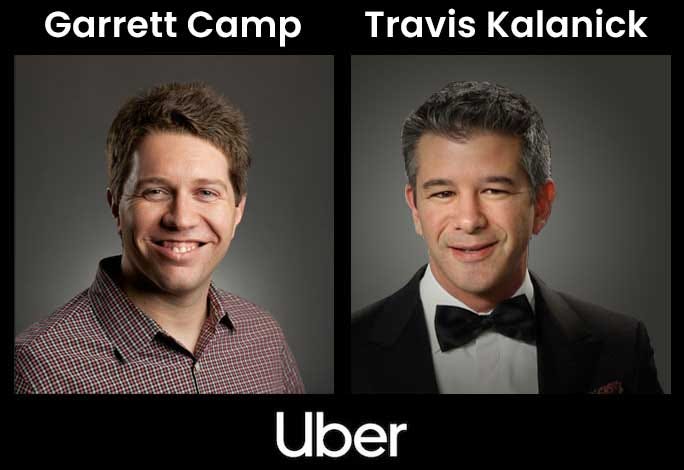
These examples illustrate the power of distinct yet overlapping skills. When one founder handles technology or product, and the other handles market, operations, or partnerships, the team can move fast, adapt, and scale while maintaining a unified strategy.
Two-person founding teams are often considered the ideal setup for a startup. Each founder brings different strengths, they share responsibility, and they can communicate easily. There’s enough variety to handle big challenges, but the team is still small and flexible enough to move quickly.
Please keep in mind that a 50-50 split isn’t always ideal. Often, one founder ends up contributing more time, effort, or resources than the other, so it’s usually fairer to divide equity based on each person’s actual contributions and long-term commitment. This approach helps prevent resentment, aligns incentives, and reflects the real value each founder brings to the startup.
The Three Cofounder Model
When a startup has three cofounders, the advantages are easy to see. More minds around the table often lead to stronger ideas, richer problem-solving, and a healthier mix of skills. This model allows a team to combine product vision with technical depth, and add operational or financial expertise on top of that. It also brings more stability, because responsibility and decision-making are not resting on only one or two people. With three people involved, the team can challenge each other in productive ways, which typically leads to better decisions and a more resilient company.
However, bigger teams come with their own challenges. Decision making can slow down because more opinions need to be heard, and disagreements become more complex to navigate. Equity splits can turn into sensitive conversations, especially if contributions are uneven or expectations differ. Internal politics can also appear if roles are unclear, or if the team has not defined from the start who makes final calls in specific areas. For a trio to work well, roles and responsibilities must be laid out clearly from day one. Without that clarity, conflict becomes more likely.
The three-cofounder model works especially well for startups that need multiple areas of expertise. Think of hardware companies that require engineering plus supply chain plus software. Or startups in heavily regulated industries where the team needs legal, technical, and commercial talent working together from the start. When complexity is high, three deep skill sets can be a major advantage.
A strong example is YouTube, founded by Steve Chen, Chad Hurley, and Jawed Karim. Hurley drove design and the overall look and feel of the product. Chen focused on engineering and scaling the platform. Karim shaped early product direction, user behavior insights, and growth concepts. Together, they built a platform that grew faster than nearly anyone expected. Their shared skills created balance, while their separate strengths allowed them to move quickly in their own areas.

Chad Hurley, Steve Chen and Jawed Karim.
Other well-known companies started with three founders too.
The unicorn Zapier, founded by Wade Foster, Bryan Helmig and Mike Knoop, combined product, engineering, and operations to build a product that now automates workflows for millions of users.
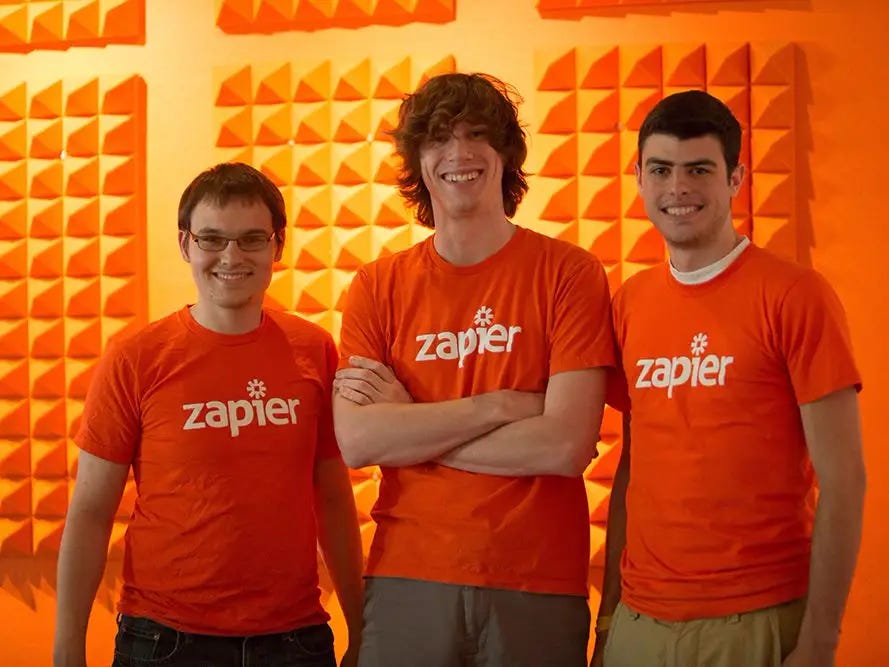
Wade Foster, Bryan Helmig and Mike Knoop.
The French example BlaBlaCar, created by Fred Mazzella, Nicolas Brusson and Francis Nappez, blended marketing, strategy, and engineering to scale a massive long-distance ride-sharing network across Europe.
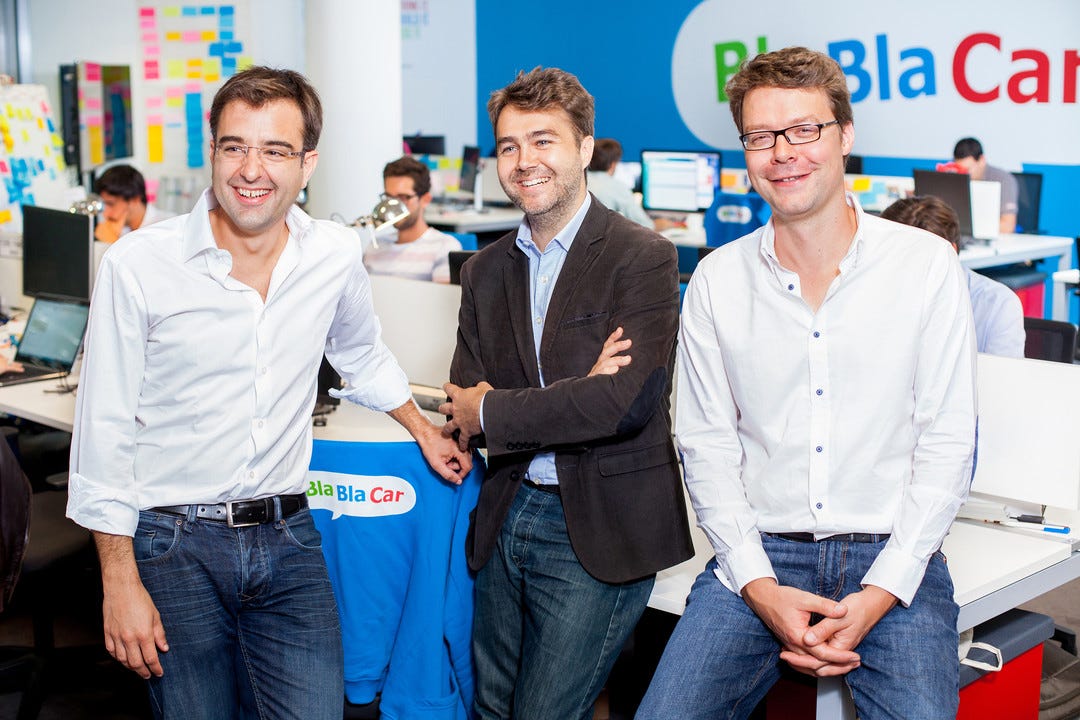
Nicolas Brusson, Fred Mazzella and Francis Nappez.
These examples show how three cofounders can provide a rich mix of skills while still maintaining enough agility to move fast. The key is simple. Define roles clearly, communicate openly, and make sure everyone knows where their authority begins and ends. When that structure is in place, three-person founding teams can be some of the strongest in the startup world.
The Four or More Cofounder Model
When a startup begins with four or more cofounders, it often feels like an upgraded version of the three-founder model. The major advantage is obvious. A larger team brings a wider range of skills, perspectives, networks, and industry connections. Each founder usually knows different people, comes from a different background, and opens different doors. This can be extremely valuable in early hiring, fundraising, product strategy, and business development. With more expertise on the table, the team can cover technical tasks, product work, finance, partnerships, and operations from day one.
The challenge is that this richness comes with a real cost. Governance becomes harder. Ownership becomes more diluted. Decision making slows down because more voices need to be heard. The potential for conflict rises sharply, especially when personalities, values, or visions clash. When a team grows beyond three founders, the risk of internal politics increases and disagreements can become deeply personal if roles are not clear.
For this model to work well, every founder must bring an essential and non-overlapping capability that the startup cannot function without early on. That is the only reason to justify such a large founding group. If the skills overlap, or if roles are fuzzy, the structure becomes unstable quickly. This is why the four-plus model is far less common and generally less sustainable unless the startup operates in an extremely complex or deeply technical field.
Still, some globally influential companies began exactly this way.
A well-known example is PayPal. The early team included Peter Thiel, Max Levchin, the Sweetheart Elon Musk, Luke Nosek and Ken Howery. Several of these founders arrived through the merger of two separate startups. X.com and Confinity. Despite the power struggles that later made headlines, the mix of technical talent, financial vision, security expertise, and product thinking created a foundation strong enough to build a global payments platform. The company’s success shows that a large founding group can work if each person’s role is vital and if the market opportunity is big enough to require such a range of skills.
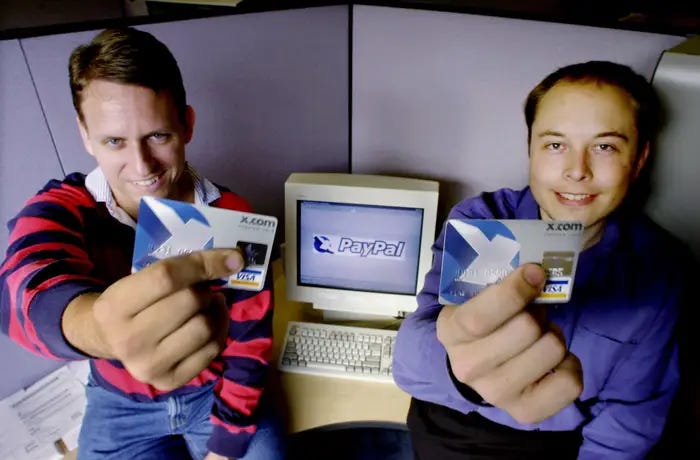
Young Peter Thiel and Elon Musk.
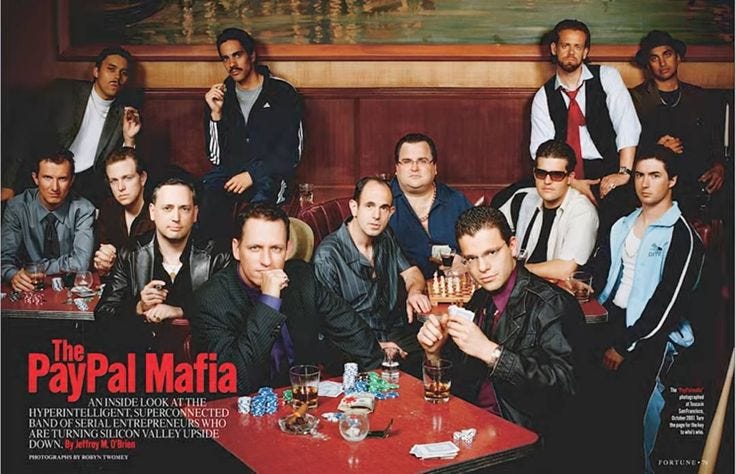
After eBay acquired PayPal in 2002, many of the early employees left and went on to found other influential tech companies. In 2007, Fortune magazine featured these alumni in an article dubbing them the “PayPal Mafia,” complete with a stylized photograph. The photo, with a mafia scene, was taken years after the PayPal sale and does not feature the same founding group, nor was it taken during the company’s early days. Elon Musk was not present for that photoshoot.
Another example comes from the biotechnology world. Moderna began in 2010 with five cofounders. An unusually large number even for a biotech startup. The size of the founding team reflected the complexity of what they were building at the intersection of academic science, medicine, engineering, and venture creation.
Noubar Afeyan provided the venture-building structure, incubation environment, and early funding. Derrick Rossi supplied the core scientific discovery around modified mRNA. Kenneth Chien contributed medical and translational expertise. Robert Langer added engineering and biomedical innovation at world-class levels. Timothy Springer brought immunology expertise and early financial backing.
None of these roles overlapped. Each founder contributed something that the others simply could not. This is why the company’s large founding team worked. The problem they were solving was so complex that no smaller combination could have covered all critical areas.
These stories highlight an important truth. Startups with four or more founders succeed only when every founder brings a uniquely essential skill set, when the team aligns on mission from the start, and when roles and decision rights are defined with absolute clarity. Without those elements, size becomes a burden rather than an advantage. With them, it becomes a powerful engine for breakthroughs that smaller teams could never achieve.
Choosing the Right Founder Model
Whether you build your startup alone or with two founders, three founders, or a larger team, each model comes with its own strengths and weaknesses. Two-person teams often feel like the perfect balance. Fast, focused, and built on complementary skills. Three-founder teams add more expertise and stability. Especially valuable when a product sits at the intersection of several disciplines. Four or more founders can unlock an incredible range of capabilities, networks, and ideas. Yet they require exceptional clarity, governance, and alignment to avoid internal friction.
There is no universal “best” structure. The right choice depends entirely on your market, your product, your personal strengths, and the level of complexity your company needs to handle from day one. What matters most is not the number of founders. It is the quality of the collaboration, the clarity of roles, and the ability of the team to navigate uncertainty together.
In the next article, I will go even deeper into these models. How to choose the right cofounder for your specific idea, how to avoid the most common traps, and how to build a founding team that investors trust. If this topic speaks to you, make sure to subscribe, share the post, and leave a comment. I would love to hear your experiences and perspectives on building a startup from the ground up.

I resonate with what you wrote... what if visions truly clash?
Interesting! I think a lot of people founding a start up don't really consider this and just start with the people that were involved with the initial idea.