
Uber: the End?
Will Uber survive the self-driving revolution..?

Uber is no longer just the app you open when you need a ride home after a night out. Over the past decade, it has transformed into a global technology platform that operates across transportation, food delivery, and logistics.
Headquartered in San Francisco, Uber employs around 35,000 people worldwide, according to PitchBook. This is a grown-up public company with real scale!
Uber’s Services
What makes Uber genuinely interesting right now is how far it's stretched beyond its original idea. The core ride-hailing business is still going strong, but delivery and freight have become major growth engines in their own right. Uber has effectively turned itself into a platform that moves both people and things and that's a much bigger business than anyone expected when it launched.
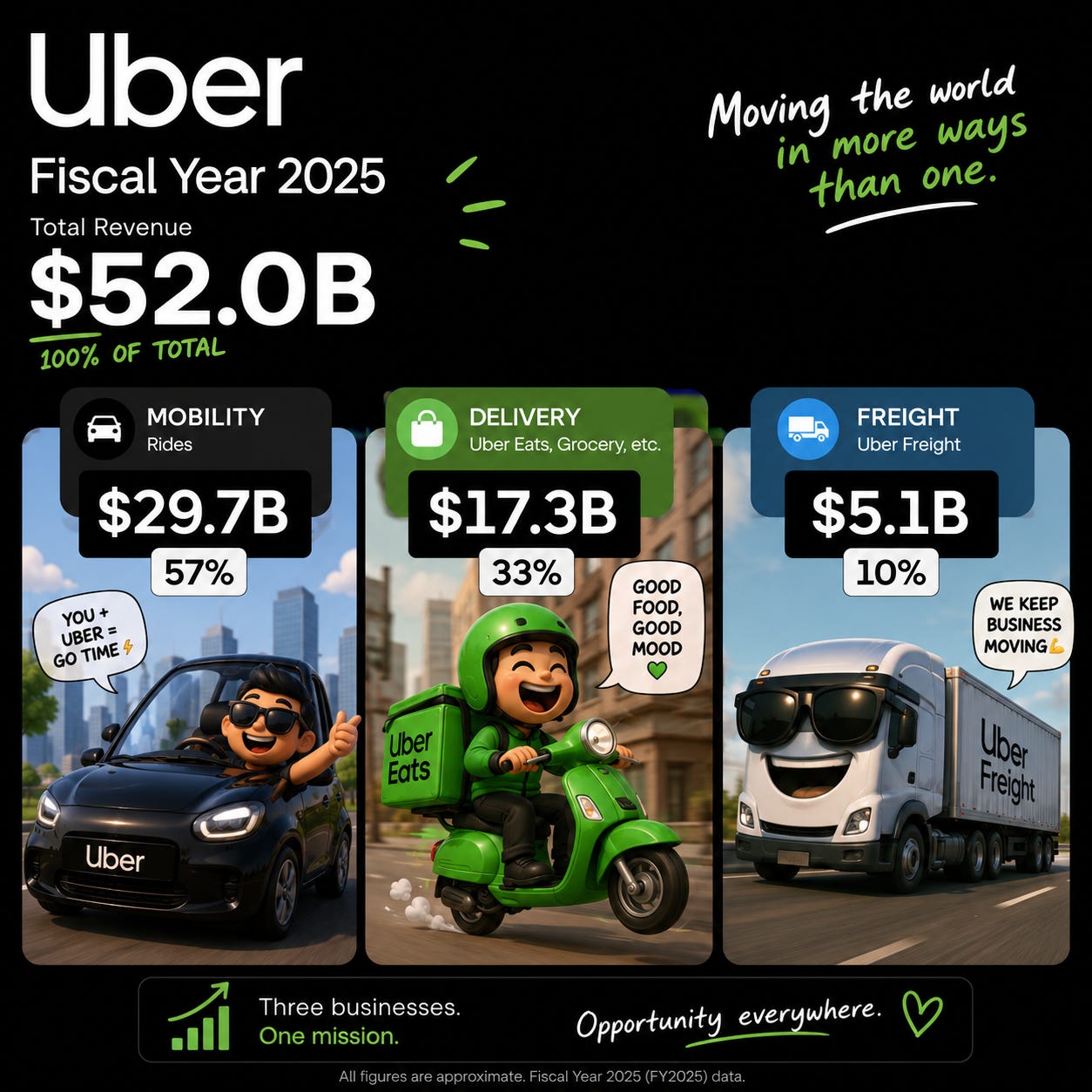
Check the latest Annual Report of Uber here.
And that’s not all…
For companies, Uber for Business simplifies corporate travel and team meal management. For patients, Uber Health solves a quiet but real problem: getting people to and from medical appointments without the stress of arranging a car. On the consumer side, Uber One is the company’s subscription play (membership that ties together ride discounts and free deliveries), making it harder to imagine life without the app. Need a car for the weekend? Uber Rent lets you book one directly without ever dealing with a rental desk. And for everyday errands, their growing Local Commerce and Grocery service means groceries, pet supplies, or a last-minute bottle of wine can show up at your door in under an hour.
Uber has gone from getting you from A to B, to basically handling the physical logistics of your life.
Uber: Behind the Stock
Uber’s journey as a public company has been anything but smooth.
When the company went public in May 2019 at $45 a share, expectations were sky high. Investors, however, were unconvinced. The stock stumbled immediately, closing its first day below the IPO price and beginning life on Wall Street with disappointment rather than celebration.
Then came 2020. As the pandemic brought cities to a standstill, Uber’s shares collapsed to around $13.70, the lowest level in the company’s history. At the time, few could have imagined that the business would eventually emerge stronger from the crisis.
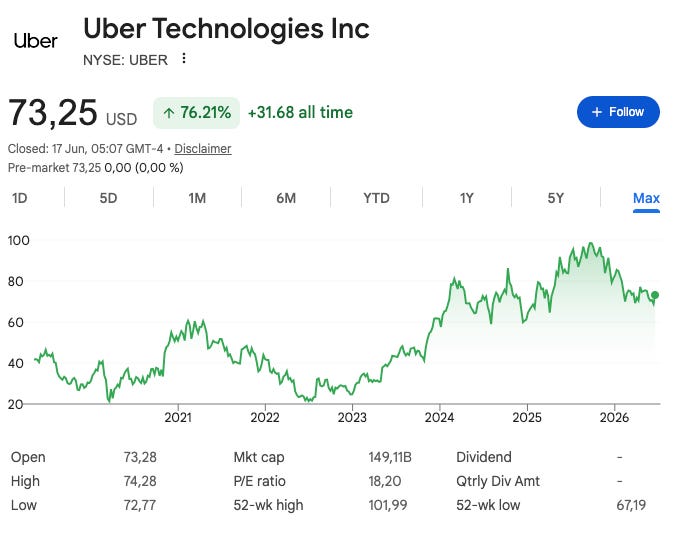
But that’s exactly what happened. As travel resumed and consumer habits shifted, Uber transformed itself. Ride demand recovered, Uber Eats became a major business, and perhaps most importantly, the company finally learned how to make money. By September 2025, Uber shares had climbed to nearly $102, an all time high.
Today, in June 2026, the stock trades around $73. That places it roughly 62% above its IPO price and more than 430% above the pandemic lows. Yet it remains almost 30% below the peak reached last year.
In other words, Uber’s stock sits somewhere in the middle of its own history. Neither particularly cheap nor excessively expensive.
What’s fascinating is that the business underneath the stock has changed dramatically. Back in 2019, Uber was losing billions of dollars and profitability seemed like a distant dream. Today, the company generates more than $50 billion in annual revenue, produces billions in free cash flow, and delivers consistent earnings.
Ironically, even though the share price is lower than it was at the 2025 peak, the company itself is arguably stronger than at any point in its history.
Sometimes the market price and the quality of the business don't move in perfect sync, dear reader. Perhaps because the future is driverless, and it’s not a guarantee Uber wins this war.
Sure, right now, companies like Waymo own the tech and the actual self-driving fleets, while Uber is just trying to be the middleman app that connects them to riders. Uber’s whole strategy is to let other companies do the heavy lifting while they take a cut.
But will that actually work? If tech giants build their own massive robotaxi fleets and launch their own apps, they could totally cut Uber out. At the end of the day, users just want a cheap, fast ride from point A to point B. If a competitor offers cleaner, cheaper, fully autonomous rides directly on their own app, Uber’s massive network of human drivers won’t matter anymore. It’s all about who wins the customer, right?
The Robotaxi Map
Let’s be honest: Europe has already lost the AI race. While European bureaucrats busy themselves writing compliance checklists :D, the US and China are busy writing the future. The entire AI ecosystem from capital to computing power is now a strict duopoly split between Silicon Valley and Beijing.
Right now in mid-2026, the global robotaxi map is highly exclusive. Commercial autonomous vehicles (AVs) are primarily scaling across the US, China, the Middle East, and selected Asian hubs.
In the US, Alphabet’s Waymo is the undisputed heavyweight champion, but the competitive landscape is shifting fast. Amazon’s Zoox is pushing hard into new cities with its custom-built pods, while Tesla continues its aggressive push to take its software fully driverless. Meanwhile, deeply funded players like Motional (backed by Hyundai) and Avride are quietly gaining massive ground by embedding their fleets directly into Uber’s network.
Waymo
Waymo started back in 2009 as Google’s secret autonomous car project when they brought on AI pioneer Sebastian Thrun. Today, the Mountain View-headquartered firm remains with Alphabet, operating privately with a lean team of roughly 2,500 employees.
And they are scaling at an unprecedented velocity.
As of mid-2026, Waymo is a fully driverless, commercial reality. They have expanded broad public access across 11 major US metropolitan areas, including San Francisco, Los Angeles, Phoenix, Austin, Atlanta, Miami, and a massive Texas footprint covering Dallas, Houston, and San Antonio.
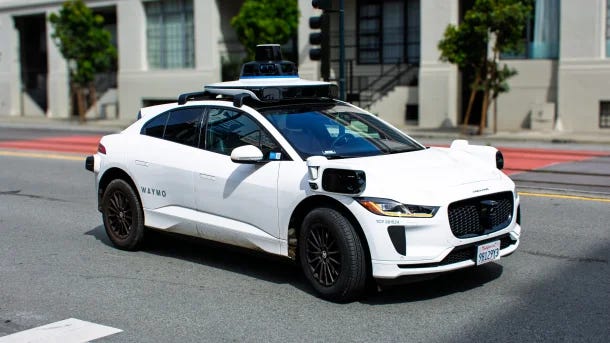
Waymo robotaxi
They have over 3,700 robotaxis out there, handling about 400,000 paid rides every week. They’ve logged 170 million fully autonomous miles, pretty massive, huh?
For expansion plans, Waymo is being quite ambitious. They raised a $16 billion funding round in February 2026 that valued the company at $126 billion. They are targeting to be in 20 or more cities by the end of 2026, and they are also planning international expansion into Tokyo and London, although regulatory approval is still pending in those places.
Safety: If you’re skeptical about riding without a driver, the data might change your mind. Waymo’s safety performance is statistically superior to humans. According to their real-world data, Waymo vehicles are involved in 92% fewer serious injury or fatal crashes than human drivers in identical conditions. Check it out here.
When you look at the raw numbers per million miles, the drop-off is striking:
Serious Injuries: Humans clock 0.22 incidents per million miles; Waymo sits at a near-zero 0.02.
Any Injury Crashes: Waymo marks a 0.41 rate vs. the human average of 2.8 (an 85% reduction).
At Intersections: Waymo’s tech proves to be 96% safer than a human driver.
While the cars drive flawlessly, using them requires a bit of patience. Waymo strictly adheres to posted speed limits, capping out at 65 mph on freeways and hovering around 25 mph on city streets. Because they use incredibly defensive routing to avoid tricky situations, studies show a standard Waymo trip can take significantly longer than an Uber or Lyft, sometimes averaging over 30 minutes for a route a human rideshare driver would zip through in 15.
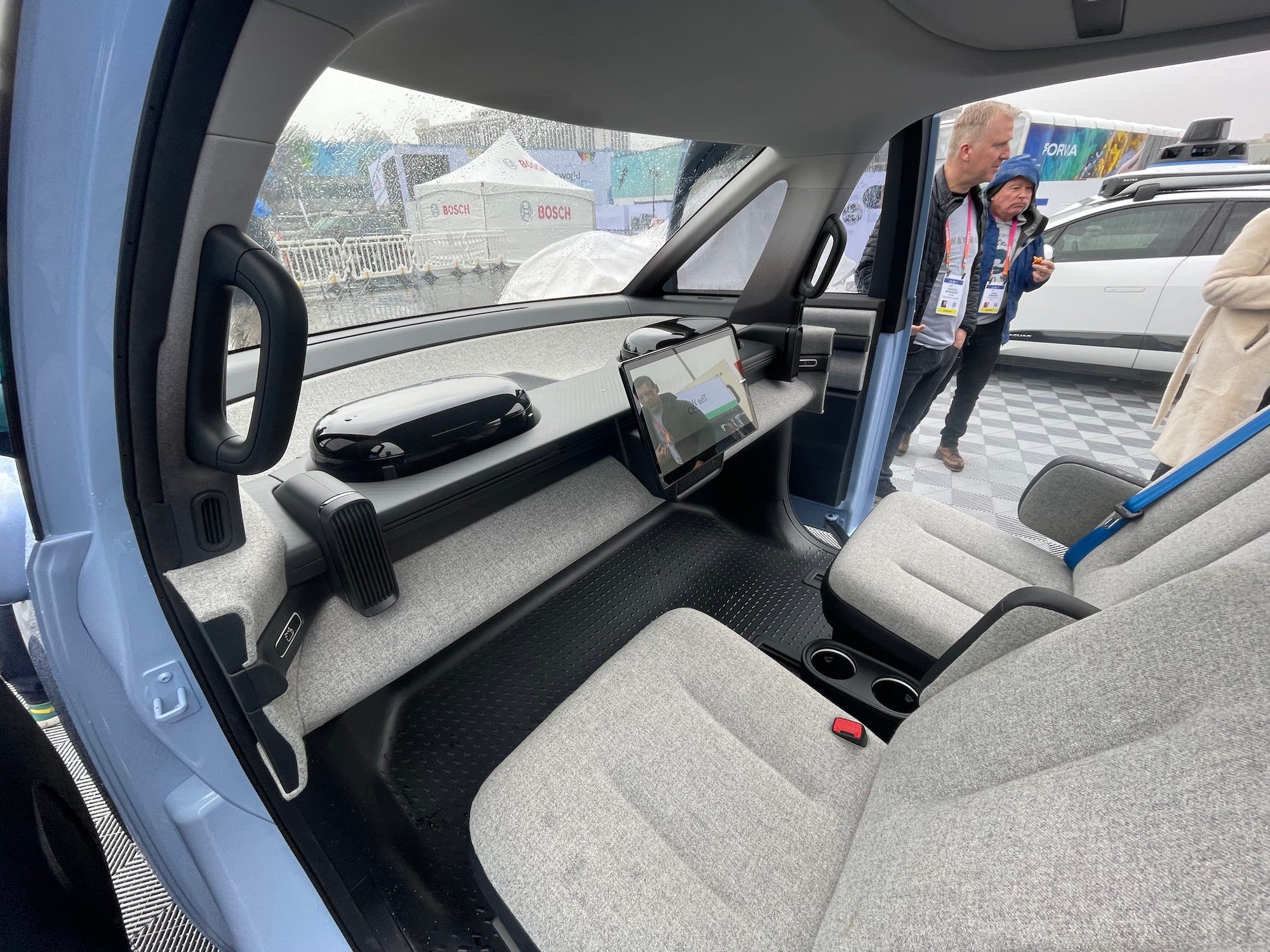
Look, ma, no steering wheel!
And you may ask, “What about the price?” A valid question!
Waymo operates as a premium product. With a median ride cost hovering around $19.69, it sits about 13% higher than Uber ($17.47) and 27% higher than Lyft ($15.47).
However, the premium gap is closing. Just a year ago, Waymo carried a massive 30% to 40% premium. Since then, Waymo has optimized costs while Uber and Lyft fares have steadily climbed. Longer rides are almost equal. On trips longer than 8 miles, Waymo often wins on price because you don’t have to tip a robot (saving you that standard 15% to 20% driver gratuity). The main pain point remains evening rush hour (5 PM–6 PM), where surging demand can cause a Waymo to cost $9 to $11 more than its human-driven counterparts.
The wildcard is Tesla. Tesla’s robotaxi average is just $8.17 and rarely exceeds $10, compared to Lyft’s $15.47, Uber’s $17.47, and Waymo’s $19.69, so Tesla is using ultra-aggressive pricing to grab market share, similar to what Uber and Lyft did when they first launched.
Next Stop: Tokyo and London
In Tokyo: Waymo has partnered with Japan’s leading taxi apps, GO and Nihon Kotsu. They are currently conducting mapped testing with safety drivers across seven major wards (including Shibuya, Shinjuku, and Minato), aiming for full commercialisation.
In London: Marking their first major footprint in Europe, Waymo is actively running autonomous trials on London roads this year with specialists behind the wheel. Partnering with fleet operator Moove and utilizing customized, all-electric Jaguar Land Rover vehicles, the goal is to launch a direct-to-consumer, fully driverless service via the Waymo app.
Tesla’s Robotaxi
Tesla currently operates in only three Texas cities: Austin, Dallas, and Houston, which, haha, are the very same cities where Waymo is already driving. It’s quite a bit less than the seven cities Elon Musk promised by now :).
And the actual fleet size is way smaller than you’d think. They have roughly 20 to 59 vehicles actively driving out there. Quite low, huh?
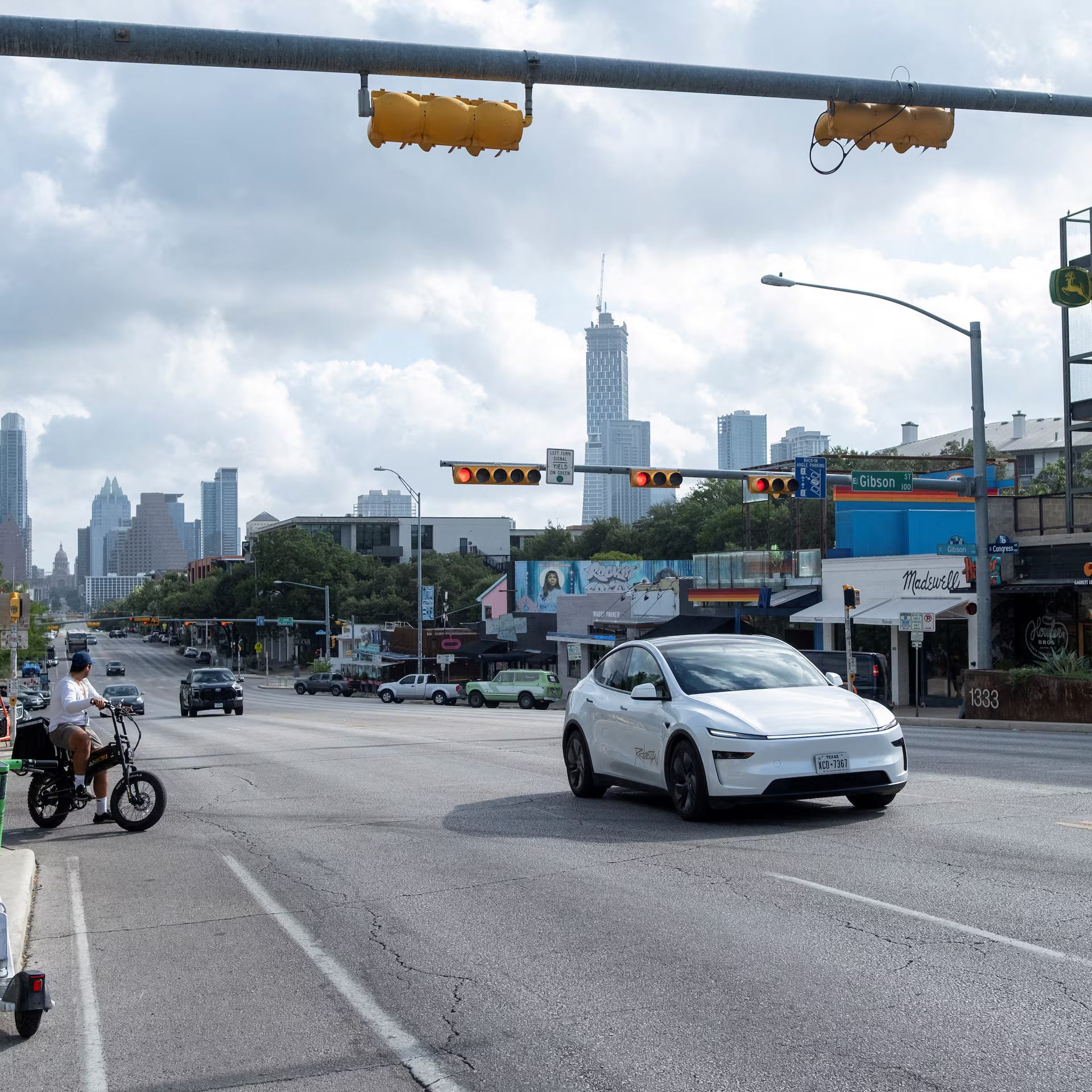
Tesla’s robotaxi in Austin, Texas
On pricing, Tesla is being aggressively cheap. Rides are running around $7 to $8, which is about half the price of an Uber or Lyft, and nearly a third of Waymo’s average.
But the trade-off is absolutely brutal. Because the fleet is so tiny, you’ll be waiting 15 to 16 minutes for a Tesla robotaxi, compared to just 3 to 6 minutes for a Waymo, Uber, or Lyft. Hope you aren’t in a rush :).
When it comes to safety, Tesla is currently going in the wrong direction. Their driverless robotaxis are crashing roughly 3 to 4 times more often than human drivers. The data from their public testing is pretty wild: Tesla Robotaxi: 1 crash every ~55,000 miles; while Human Drivers: 1 crash every ~500,000 miles. Tesla has clocked around 17 crashes total across 800,000 driverless miles driven. So while Waymo is genuinely safer than human drivers, Tesla’s driverless tech is still significantly worse.
The Roadmap (Or Lack Thereof): Looking ahead, Tesla promised to expand to 7 more cities in the first half of 2026, but they are significantly behind that timeline. Mi querido Amigo, Elon, is still targeting a 1,000-vehicle fleet by the end of the year, which honestly seems like a massive stretch given where they are sitting right now.
Tesla’s global plans look pretty ambitious on paper, but they are entirely at the mercy of regulators:
Europe (excluding Switzerland): Tesla is eyeing a broad rollout right now mid-year. But let’s be clear: this is for Full Self-Driving SUPERVISED capabilities (meaning a human still has to hold the wheel) rather than a true, driverless robotaxi service. They just picked up historic approvals in the Netherlands, Denmark, and Belgium, with Germany and the UK up next. But a fully driverless Tesla robotaxi in Europe? Zero operations exist yet; it all hinges on rigid regulatory type approvals. Considering the notoriously stale and strict European bureaucracy, this feels like Mission: Almost Impossible, right?
China: They’ve secured initial nods to test, but what broader commercialisation actually looks like there remains completely up in the air.
For now, Tesla is a budget-friendly science experiment, while Waymo is a premium chauffeur.
Robotaxis in China
In China, the robotaxi market is growing rapidly, driven by government-backed pilot zones in cities like Beijing, Shanghai, and Guangzhou. Baidu’s Apollo Go leads with around 1,000 vehicles, while Pony.ai has about 250, and WeRide operates roughly 100 vehicles in Guangzhou. The goals are big: Baidu aims to expand to 100 cities by 2030, Pony.ai plans to grow to over 10,000 by 2028.
The major players (Baidu, Pony.ai, and WeRide) do have their own fleets. They’ve invested heavily in autonomous vehicles, so they’re operating and managing their own cars rather than just partnering with existing ride-hailing drivers. They do sometimes collaborate with automakers, but the core fleet is theirs.
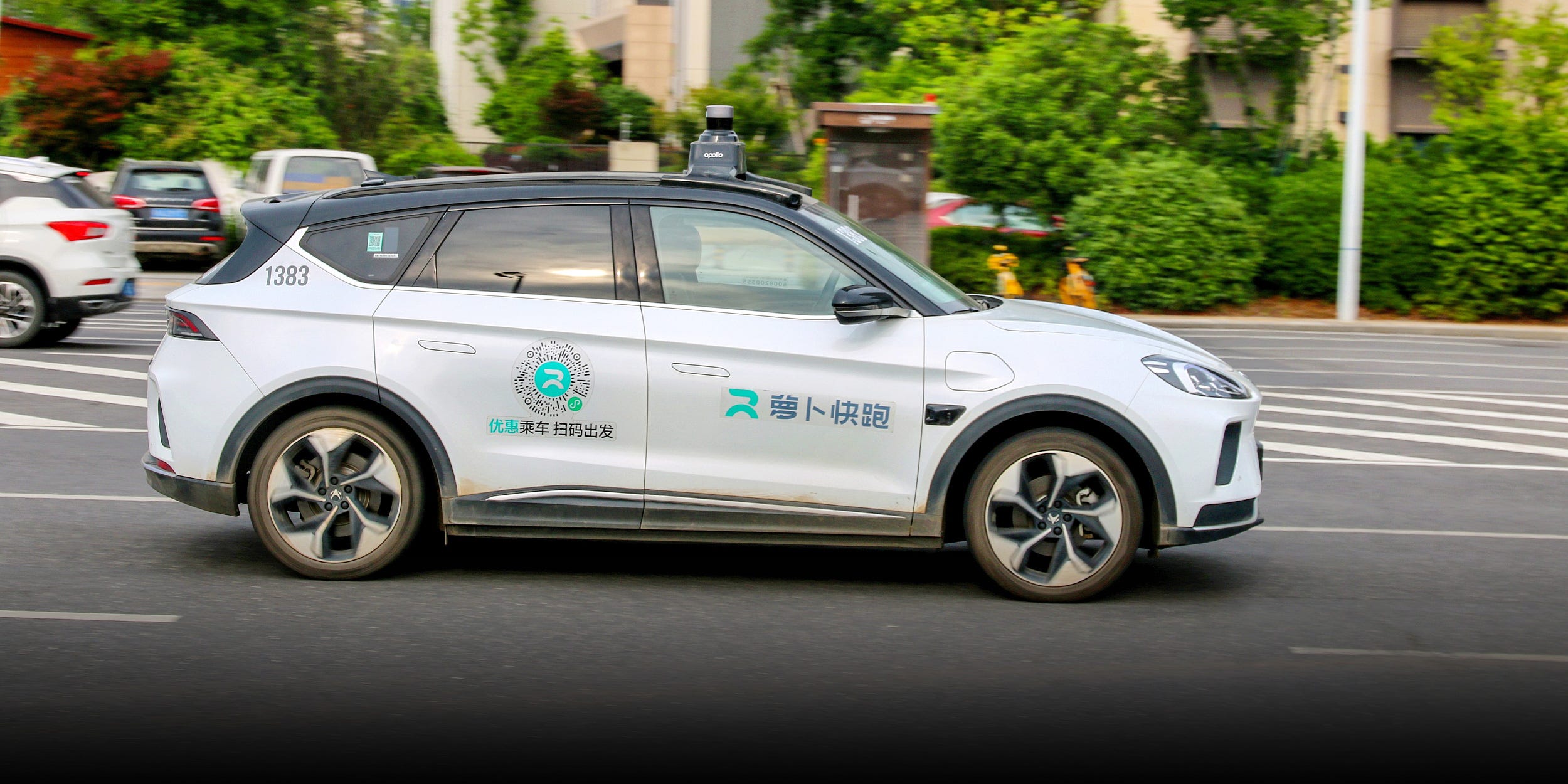
Baidu’s Apollo Go robotaxi
When it comes to actual trip times, Chinese robotaxis are catching up to traditional rideshares, but they still struggle to beat a human driver.
Baidu’s vehicles can comfortably cruise up to 70 or 80 km/h on open routes. But in dense, chaotic city centers, human drivers are still noticeably faster. Why? Because humans take aggressive, flexible shortcuts and split-second risks, while the robotaxis remain rigidly locked into extra safety measures and defensive routing. They are close, but the human hustle still wins out for now.
Escaping the Homeland
The most exciting shift right now mid-2026 is that Chinese AV tech is aggressively breaking out of its domestic borders:
The Middle East: WeRide has already successfully launched a fully driverless robotaxi service on the streets of Abu Dhabi.
Singapore: In a massive milestone for Southeast Asia, WeRide teamed up with the region’s super-app, Grab. They’ve rolled out a public autonomous shuttle service (called “Ai.R”) in Singapore’s residential Punggol district.
Switzerland: In a stunning regulatory first, Baidu’s Apollo Go just locked down an official Level 4 autonomous permit in Switzerland. Operating under the name “AmiGo” in a joint venture with the Swiss PostBus, they’ve officially deployed fully electric pods to navigate the tricky terrain of the Alpine foothills. They are targeting full public commercial rollouts by 2027.
Europe might be strict, but China’s tech is officially putting wheels on European soil.
Uber: Game Over?
It’s a fascinating dynamic. For a long time, the narrative was that Waymo would eventually put Uber out of business by removing the need for human drivers. However, Uber is trying to shift its strategy to ensure it remains the “central nervous system” of the ride-hailing world, regardless of who owns the robot.
As of early 2026, Uber is moving from being a simple partner to a direct competitor with its own “asset-heavy” fleet strategy.
The “If You Can’t Beat ‘Em, Host ‘Em” Phase (2024–2025)
Initially, Uber pivoted from building its own tech (after selling its ATG unit) to becoming a platform for others. Just to offer robotaxis services through their app. Sorry, that's not a strong argument for me.
The main advantage: Uber doesn't have to buy expensive vehicles, maintain depots, or pay for cleaning and charging. They generate high-margin revenue purely from software matching, but it is not sustainable.
Why it won’t! work: A large user base alone is not a moat if your service is expensive. Building an app is relatively easy. By giving the app, Uber is giving its most valuable asset its customer base to its chief competitor. Once customers get used to autonomous rides, they might realise Waymo offers a more consistent experience and cut out the Uber middleman entirely.
The Shift to “Direct Competition” (Late 2025–2026)
Great that Uber realised that the app alone, even with a large client base, won't be enough. It really won’t! In a major move, Uber is now transitioning from “platform dependency” to owning and operating its own autonomous fleets. This signals a strategic split from Waymo in several key markets:
The Lucid-Nuro Partnership: At CES 2026, Uber unveiled a purpose-built robotaxi developed with Lucid (the vehicle) and Nuro (the AI driver). Uber plans to deploy these in San Francisco by late 2026, taking the fight directly to Waymo’s home turf. Good.
Asset Ownership: For the first time in years, Uber is buying its own vehicles (over 20,000 units committed) rather than just being a middleman. This allows them to control the “in-cabin” experience and potentially lower costs further. Good.
NVIDIA Collaboration: Uber is working with NVIDIA to build a massive “AI data factory” to help scale their global autonomous fleet to an estimated 100,000 vehicles by 2027. Great.
What is good in this strategy: By owning the fleet (the Lucid/Nuro vehicles), Uber is no longer at the mercy of Waymo's pricing or platform rules. They control their own destiny. Uber can fully control the "in-cabin" experience, entertainment, cleanliness, and branding, which is highly variable. By building an AI data factory with NVIDIA, the more miles Uber's fleet drives, the smarter their routing and dispatch algorithms become, unlocking massive efficiency gains over time.
Why it might not work: Buying 20,000+ custom electric robotaxis destroys Uber’s hard-earned profitability. They shift from a lean software company to a heavy logistics and maintenance company, which Wall Street traditionally dislikes. Moreover, Waymo has over a decade and billions of miles of real-world testing. Nuro and Lucid are incredibly capable, but launching a brand-new autonomous stack directly into San Francisco (Waymo’s stronghold) risks high-profile software failures or accidents that could damage Uber’s brand.
The Global Multi-Partner Strategy
Unlike Waymo, which mostly uses its own proprietary “Waymo Driver,” Uber is playing the field with a “multi-AI” approach:
In Europe: Partnering with Wayve and Volkswagen (using the ID. Buzz) to launch robotaxi services in London, Madrid, and Munich.
In the Middle East: Deploying over 1,000 robotaxis in Dubai and Abu Dhabi through partnerships with Baidu (Apollo Go) and WeRide.
In Freight: Partnering with Waabi and Aurora to integrate self-driving semi-trucks into Uber Freight.
Why it can work: Geopolitics make it impossible for an American company like Waymo to launch in China, or for a Chinese company like Baidu to dominate the US. By partnering with local heroes (Baidu/WeRide in Dubai, Wayve/VW in Europe), Uber bypasses political friction. Uber isn’t putting all its eggs in one autonomous basket. If Nuro’s software hits a development bottleneck, Uber’s business survives because they are also integrated with Wayve, Waabi, and Aurora. Bringing autonomous tech to Freight (trucking) opens up a completely separate multi-billion-dollar revenue stream where Waymo has significantly scaled back its focus.
Why it might fail: Managing many different autonomous vehicle APIs, safety protocols, and hardware requirements across different continents can be difficult. Because Uber is using third-party AI drivers everywhere globally, they never truly own the core intellectual property. If Volkswagen or Baidu decides to launch their own competing ride networks locally, Uber can be booted out of those markets overnight.
What do you think, will Uber actually pull this off? Are they going to win the self-driving race because everyone already has the Uber app on their phone? Or are we watching the beginning of the end for Uber, destined to go down in history like Blockbuster or Kodak because pure AI companies like Waymo are just too fast?
If you enjoyed this post, subscribe to get more insights from the startup world. Don’t forget to like and share this with others who might find it interesting!
No end… :)
Uber once invested vast sums to acquire market share.
Now boasting an 11.7% operating margin on $53.687 million in revenue, coupled with three bold strategies.
This could pay off.
We're opening a small position and will wait for the next earnings call before taking further action.
Beautiful article thank you!